From Page to Stage to Album to Book: A Poetic Journey in Four Forms
/ Production
Author(s): Marina Otchuda Say Gynt
Performing/Reading/Singing: Joanna Doe
New York
Croatia
☞ For interviews, bookings, or other inquiries: info@arktik.eu, +385 99 200 40 40, +1 929 774 2754. Za intervjue, gostovanja ili druge upite: info@arktik.eu, +385 99 200 40 40.
Concept / Description
Poetry in Multiple Forms
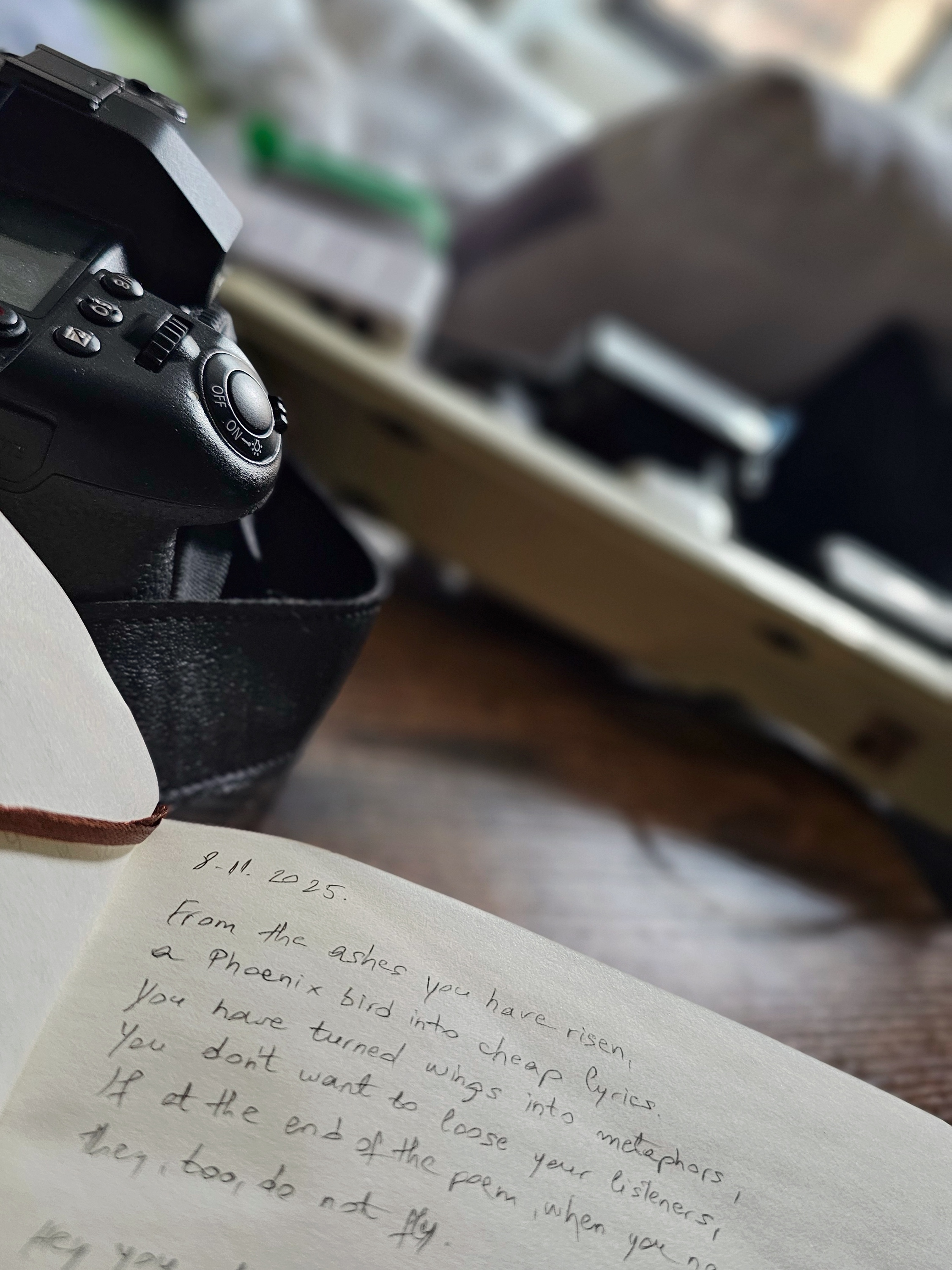
Marina Otchuda Say Gynt’s Poetry Meets Amnesia exists simultaneously as written text, performed voice, a music album in the making, and a book to be published when time calls for it—committed to process over product. This is not a finished book, but an ongoing conversation with listeners, the city, and the fractured self.
The Power of Live Performance: Through the Performing Heart of Joanna Doe
What distinguishes this work is its commitment to live performing. These poems exist most fully in performance—in the moment when voice meets ear, when Joanna Doe whispers in a poetry jam and the room falls silent.
Joanna Doe—performer, persona, amnesiac wanderer—carries these poems through poetry jams, music venues, cold readings, and experimental performances. This is poetry not as finished product, but as ongoing practice. As ritual. As survival.
Born from Extremity
These poems speak from positions of vulnerability: the woman with no memory, no papers, no fixed identity. The lover betrayed. The migrant witnessing environmental collapse. The artist interrogating whether art means anything in late capitalism. Rather than despair, what emerges is radical presence—a refusal to be erased, documented, or simplified.
Language Across Scales
Bilingual in English and Croatian, the poems formally oscillate between intimate lyric, political manifesto, and incantatory ritual. Language shifts from cosmic metaphor (“galaxies,” “deatomize”) to brutal bureaucracy (“Hello, Joanna Doe?”), from intimate address (“Can we talk?”) to collective call-to-rise (“Listen to me, America”). This formal restlessness forces readers and listeners between scales: personal, political, spiritual, ecological.
Dissolution and Reconstruction
Thematically, the collection centers on breaking and reassembly. Relationships dissolve and reform. Identities shatter and reassemble. Bodies “deatomize” only to rebirth. The Shoebox Gem is smashed and kintsugi’d. The Phoenix burns and rises. This hard-won knowledge recognizes that freedom requires the destruction of old ways.
Speaking from the Margins
Politically, these poems name and rage against immigration bureaucracy, capitalist consumption, media manipulation, environmental destruction, and patriarchal violence. Yet they speak from the margins—through a persona with no documentation, no fixed identity, no claim to authority. In doing so, they model a speaking-from-nowhere that paradoxically becomes the most powerful testimony.