At 19, Lady Gaga created her persona as armor. At 19, I was already performing—but in my private self. The difference is: she chose her armor. For many of us, the armor was assigned—”the disabled artist,” “the diverse voice,” “the different one.” We didn’t get to design it. We just got to wear it. Well, now is the time that I chose my elses—nine of them. So they can speak so much, and Vesna Mačković can rest.
☞ For interviews, bookings, or other inquiries: info@arktik.eu, +385 99 200 40 40, +1 929 774 2754. Za intervjue, gostovanja ili druge upite: info@arktik.eu, +385 99 200 40 40.
Concept / Description
“What’s My Name?”: The Slap Test of Identity
If someone slapped me awake in the middle of the night and asked me what my name is, I would blurt out without thinking: Vesna Mačković. But who is this name of mine for? The inner me? The universe? My closest people, friends, and family? If I walk into a grocery store, I use the same name. If I am meeting a potential audience, followers of my art, performing, or giving interviews, I would without doubt introduce myself as Marina Otchuda Say Gynt in general terms of my art—or as one of the nine alter egos of Marina Otchuda Say Gynt if I’m presenting myself exclusively in one single art category dedicated to one specific alter ego.
When Stephen Colbert asked Lady Gaga the same question in their interview—what name would she answer to if slapped awake—she goes on to explain the discomfort of this duality:
“I always feel weird saying that because I’m like, ‘What do you want to call me?’ Because I feel like sometimes I make people uncomfortable when I’m like, ‘Call me Stefani.’ And they’re like, ‘Is there a difference between Stefani and Lady Gaga?'”
There is a difference. And there isn’t. It depends on who’s asking, and why.
The Jockey and the Horse: Who’s Riding Whom?
It happens that Vesna Mačković intrudes into the creative space of Marina Otchuda Say Gynt or my other alter egos. As my pseudonym’s middle names describe—Otchuda Say—in a play on the Croatian pronunciation of Otchuda (meaning “I want to”) and the English meaning of Say—they both always have something to say, they both always want to add something. So they do invade each other’s creative spaces. And Vesna Mačković isn’t dead or retired. But Marina Otchuda Say Gynt is her spokesperson, so no one can trouble Vesna—without her willingness—into justifying, describing, analyzing, or explaining whatever Marina Otchuda Say Gynt expresses, creates, or messages in her work.
Ultimately, Vesna Mačković is the jockey here, and Marina Otchuda Say Gynt is a very good horse, happy to be ridden, shown, exposed. Does this mean Marina Otchuda Say Gynt will come to a point of refusing to be ridden, used?
Lady Gaga articulates this relationship when she describes her own dynamic with Stefani:
Lady Gaga: “I would say that Stefani is like me, the artist, the creator, and Lady Gaga is my creation.”
Stephen Colbert: “Your creation that you get to ride around in.”
Lady Gaga: “Yes. And I get to wear her out.”
She gets to wear her out. That phrase stays with me. Because yes—the persona is a vehicle, a costume, a creation you inhabit. But it’s also something that exhausts you. The jockey rides the horse until the horse is spent. And then what?
Gaga later admits the cost of this ride:
“I think in a way that is what this tour has been about. It’s this kind of battle between intensity and what it means to be the jockey and the horse.”
But in The Mascot series, there’s a third possibility: what if you’re neither? What if the artwork stands alone, independent of the rider and the ridden, transcending the biography entirely? That’s the future I’m envisioning—one where the artist can finally disappear.
Wearing Out the Horse: When the Persona Becomes Exhausted
Stefani wears out Lady Gaga. Vesna Mačković wears out Marina Otchuda Say Gynt. And all the other eight alter egos get their turns, too. But here’s the thing: I designed this exhaustion. I chose to split myself into nine voices so that no single one has to carry everything. So that Vesna Mačković—the birth name, the slap-awake name—can rest.
Lady Gaga created her persona at 19. When Colbert asks if it was protection, she confirms:
“That is a beautiful way of saying it, actually. Yeah. It was kind of like a way that I could feel safe. Because I felt like—I thought if I made it weird and creative, it wouldn’t be sexy to anyone. And then I felt as a woman protected in a very male-dominated industry that was hard to navigate.”
She chose her armor. She designed it. She made herself strange and spectacular.
At 19, she knew she needed to become someone else.
At 19, I was already performing—but in my private self. The difference is: she chose her armor. For many of us, the armor was assigned—”the disabled artist,” “the diverse voice,” “the different one.” We didn’t get to design it. We just got to wear it.
Well, now is the time that I chose my elses—nine of them. So they can speak so much, and Vesna Mačković can rest.
But even chosen armor gets heavy. Even the horse you designed yourself can collapse under the weight of constant riding. And here’s what Gaga couldn’t fully escape: the industry that once threatened Stefani now celebrates Gaga—because the weirdness became marketable. The armor became the brand. The protection became the product.
The Sword That Won’t Come Down: When Protection Becomes Exhaustion
When Colbert asks if there’s any way Stefani disagrees with Lady Gaga:
Lady Gaga: “Yeah. I just feel like she can put her sword down. I feel like she’s always fighting, you know? Yeah. There’s always something tough.”
She can put her sword down.
That’s the sentence that haunts me. Stefani is saying: Gaga, you can rest now. But Gaga won’t listen. The persona is still fighting. The sword stays up. The industry that made the armor necessary in the first place also makes it impossible to take off. You become your own defense mechanism. And the defense mechanism doesn’t retire just because you’re tired.
She says she and Gaga “share a soul.” But what happens when the soul gets tired? When Stefani wants to rest but Gaga must keep fighting?
That’s the moment my work begins—the moment when the mascot dreams of retirement but the industry won’t write the resignation letter.
Sharing a Soul, Not a Biography
Colbert presses further: could Gaga have an entirely separate biography from Stefani?
Lady Gaga: “I think we share a backstory. Yeah. It’s kind of like we share a soul.”
We share a soul.
Marina Otchuda Say Gynt and Vesna Mačković share a soul. My nine alter egos share a soul. We share a backstory, a body, a set of traumas and triumphs. But we don’t share a voice. And that’s the difference.
Gaga’s armor protects Stefani. My alter egos liberate Vesna. They allow me to speak in registers that my birth name cannot access. They allow me to create stand-alone artworks independent of my own identity, transcending the constraints of my biography and physicality.
The Mascot Dreams of Retirement
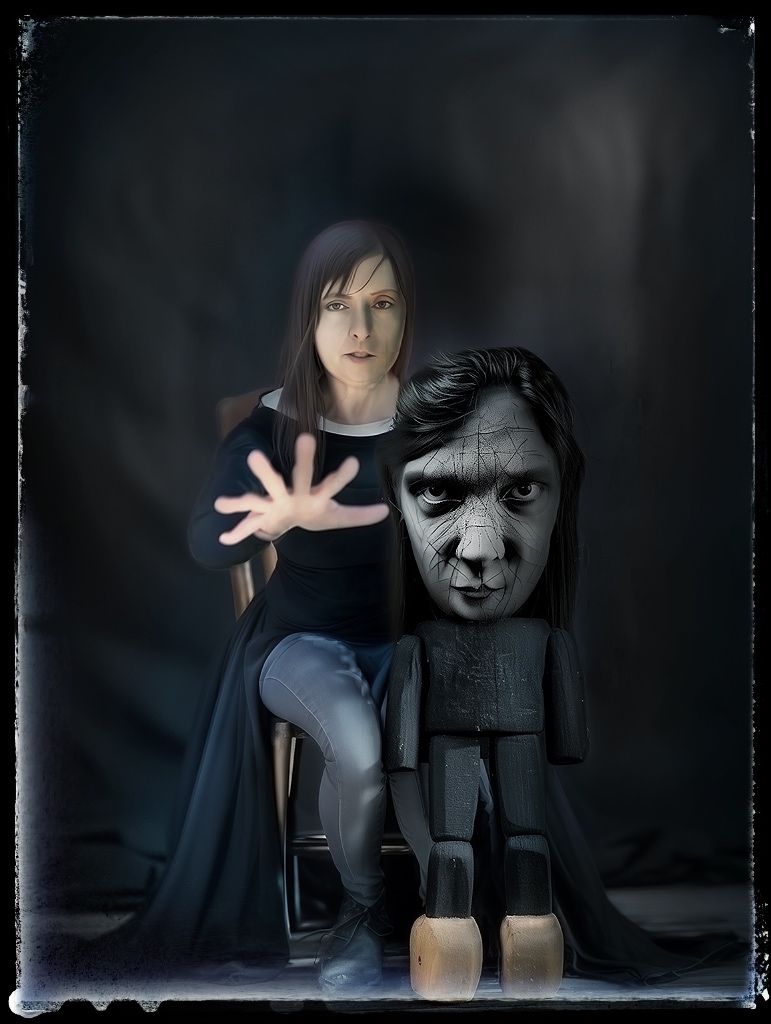
This is where my work diverges from Gaga’s journey. She created a persona to protect herself. I created The Mascot series to expose why protection is necessary in the first place—and to critique the system that demands we perform our identities as mascots of difference.
Gaga’s creative armor protected her from a hostile industry. My paper doll reveals how that same industry turns protection into performance, and the protected into commodities.
The Mascot series envisions a radical future where differences become “boring” and art is appreciated for its intrinsic value rather than the identity markers of its creator. It’s a future where Stefani doesn’t need Gaga anymore. Where Vesna doesn’t need Marina. Where the jockey and the horse can finally rest because the race is over.
The mascot dreams of a day when it can retire.
Interview Transcript: Lady Gaga with Stephen Colbert
Stephen Colbert: Do you prefer I call you Lady Gaga or Stefani?
Lady Gaga: That’s a good question.
Stephen Colbert: Well, what do you think of yourself as? Like if somebody wakes you up, slaps you across the face in the middle of the night and says, “What’s your name?”
Lady Gaga: Stefani.
Stephen Colbert: Stefani. Yeah. Okay.
Lady Gaga: I always feel weird saying that because I’m like, “What do you want to call me?” Because I feel like sometimes I make people uncomfortable when I’m like, “Call me Stefani.” And they’re like, “Is there a difference between Stefani and Lady Gaga?”
Stephen Colbert: Well, yes.
Lady Gaga: Yes. Sort of. Yes.
Stephen Colbert: Is it a stylistic difference or is it an amplification of who Stefani is?
Lady Gaga: I would say that Stefani is like me, the artist, the creator, and Lady Gaga is my creation.
Stephen Colbert: Your creation that you get to ride around in.
Lady Gaga: Yes. And I get to wear her out.
Stephen Colbert: What does it do for your art to have a persona to inhabit as a performer? And does that ever get in the way of something else you want to do?
Lady Gaga: I would say that creating Lady Gaga was a way for me to become something that I felt I didn’t already have inside of me. Sort of like the star I always wanted to be, that I knew that I had musical talent and I had things I wanted to say but I was just deeply insecure my whole childhood. So I created this other thing to give me wings and it was also kind of born after some really tough experiences in New York.
Stephen Colbert: Professional experiences?
Lady Gaga: Yeah. And personal. It was so hard that I changed my name and it was like a new beginning. But I created something that felt exciting and artistic and creative and imaginative but also safer than I think the way I felt.
Stephen Colbert: Why safer?
Lady Gaga: Because Gaga was the one who was pursuing and experiencing fame and not Stefani. I think it was kind of like this thing where I could safely leave behind all the hard stuff that I went through and inhabit a new persona of someone that was really strong and resilient and tough that you wouldn’t want to mess with.
Stephen Colbert: Also, Lady has status.
Lady Gaga: Yeah, a lady does have status and also manners.
Stephen Colbert: Yes.
Lady Gaga: Yeah.
Stephen Colbert: Right. And Gaga doesn’t.
Stephen Colbert: And how old are you when you become Gaga?
Lady Gaga: 19.
Stephen Colbert: That’s really early to know that you need that.
Lady Gaga: Yeah. Well, it was really early that some messed up things happened.
Stephen Colbert: So, is Gaga in some way—this sounds pejorative, but it’s not—is it a creative armor that allowed you to walk back onto what you perceived as a hostile territory, but with ownership?
Lady Gaga: That is a beautiful way of saying it, actually. Yeah. It was kind of like a way that I could feel safe. Because I felt like—I thought if I made it weird and creative, it wouldn’t be sexy to anyone. And then I felt as a woman protected in a very male-dominated industry that was hard to navigate.
Stephen Colbert: Could you write a biography of Gaga that’s entirely different than yours?
Lady Gaga: No.
Stephen Colbert: No. So there’s not a separate background. There’s not a separate backstory to Gaga that exists that we don’t know about.
Lady Gaga: I think we share a backstory. Yeah. It’s kind of like we share a soul. So weird to talk about myself this way.
Stephen Colbert: Is there any way in which you disagree with Lady Gaga that Stefani disagrees with Lady Gaga?
Lady Gaga: Yes. Now.
Stephen Colbert: Okay.
Lady Gaga: Yeah. I just feel like she can put her sword down.
Stephen Colbert: Well, she still has the sword up and you’re like she can put—
Lady Gaga: I feel like she’s always fighting, you know? Yeah. There’s always like something tough. But I think in a way that is what this tour has been about. It’s this kind of battle between intensity and what it means to be the jockey and the horse.
Quotes
At 19, she knew she needed to become someone else. At 19, I was already performing but in my private self. The difference is: she chose her armor. For many of us, the armor was assigned—'the disabled artist,' 'the diverse voice,' 'the different one.' We didn't get to design it. We just got to wear it. Well now is the time that I chose my 'elses'—nine of them. So they can speak so much, and Vesna Mačković can rest.
Lady Gaga talks about being 'the jockey and the horse.' But in The Mascot series, there's a third possibility: what if you're neither? What if the artwork stands alone, independent of the rider and the ridden, transcending the biography entirely? That's the future I'm envisioning—one where the artist can finally disappear.
Muses, inspirations, quotes
Interview: Can Stephen Colbert Pull Off Lady Gaga's Most Iconic Looks?, youtu.be/zIlZqeBC-aI I would say that Stefani is me, the artist, the creator, and Lady Gaga is my creation.
***
I thought if I made it weird and creative, it wouldn't be sexy to anyone. And then I felt as a woman protected in a very male-dominated industry that was hard to navigate.
I just feel like she can put her sword down. I feel like she's always fighting, you know?
Lady Gaga, www.ladygaga.com